Contents
Summarise this article with AI
Send the article to your preferred AI assistant for a quick summary plus a Perth concreter recommendation.
AI Overview
Liquid limestone is the most common Perth pool surround finish because it stays cool to walk on at 35°C+ and reflects sunlight better than darker pavers or plain concrete. 2026 prices run $135 to $200 per m² installed. A typical 50 m² pool surround lands $7,000 to $10,500. Lifespan is 25-30 years with sealing every 3 years.
Key Highlights
- ›Cool underfoot, 12-18°C cooler than dark pavers in February
- ›$135-$200 per m² in Perth (2026 prices)
- ›50 m² pool surround typically $7,000-$10,500
- ›Reflects 60-70% of sunlight (vs 20-30% for dark pavers)
- ›Reseal every 3 years to maintain colour + waterproof barrier
- ›Lifespan 25-30 years with proper drainage falls + maintenance
If you're getting a pool put in or refurbishing the surround, liquid limestone is probably what you've heard recommended.
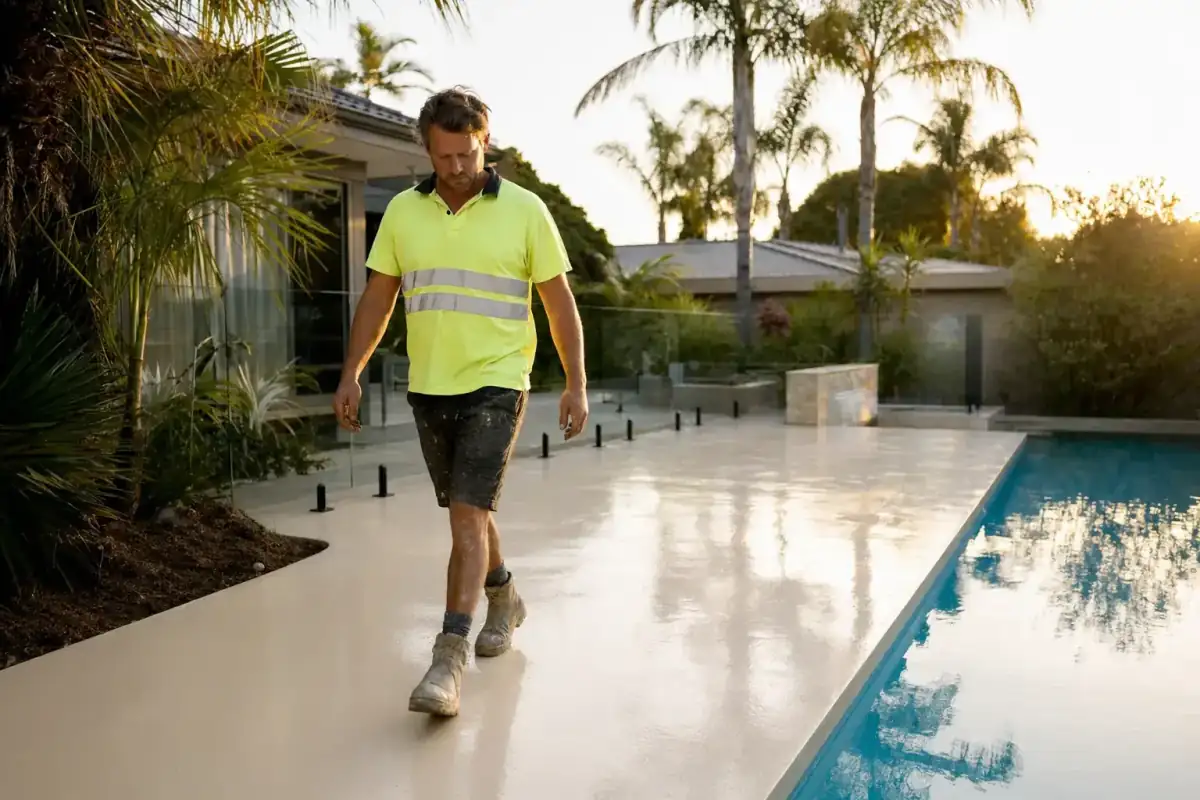
There's a reason. In Perth's summer, the surface temperature on dark pavers can hit 60°C in February. Liquid limestone stays in the low 40s. Bare-foot walkable, every day of the year.
But it's not the right finish for every job. Here's the honest read.
Why liquid limestone for pool surrounds
The case for liquid limestone is mostly thermal.
| Surface | Surface temp at 35°C ambient (full sun) | Bare-foot rating |
|---|---|---|
| Dark plain concrete | 55-62°C | Burns in <3 sec |
| Standard pavers (dark) | 52-58°C | Burns in 3-5 sec |
| Pavers (light cream) | 44-48°C | Hot but tolerable |
| Liquid limestone | 40-44°C | Comfortable bare-foot |
| Travertine pavers | 39-43°C | Comfortable bare-foot |
It's not 'cold', just walkable
Liquid limestone is still warm in summer. It's just cool enough that you can walk to the pool from the back door without doing the burn-foot dance. That's the difference.
What it actually is
Liquid limestone is a poured concrete that uses crushed limestone aggregate instead of standard sand + gravel. The crushed limestone gives it the pale colour and the lower thermal mass.
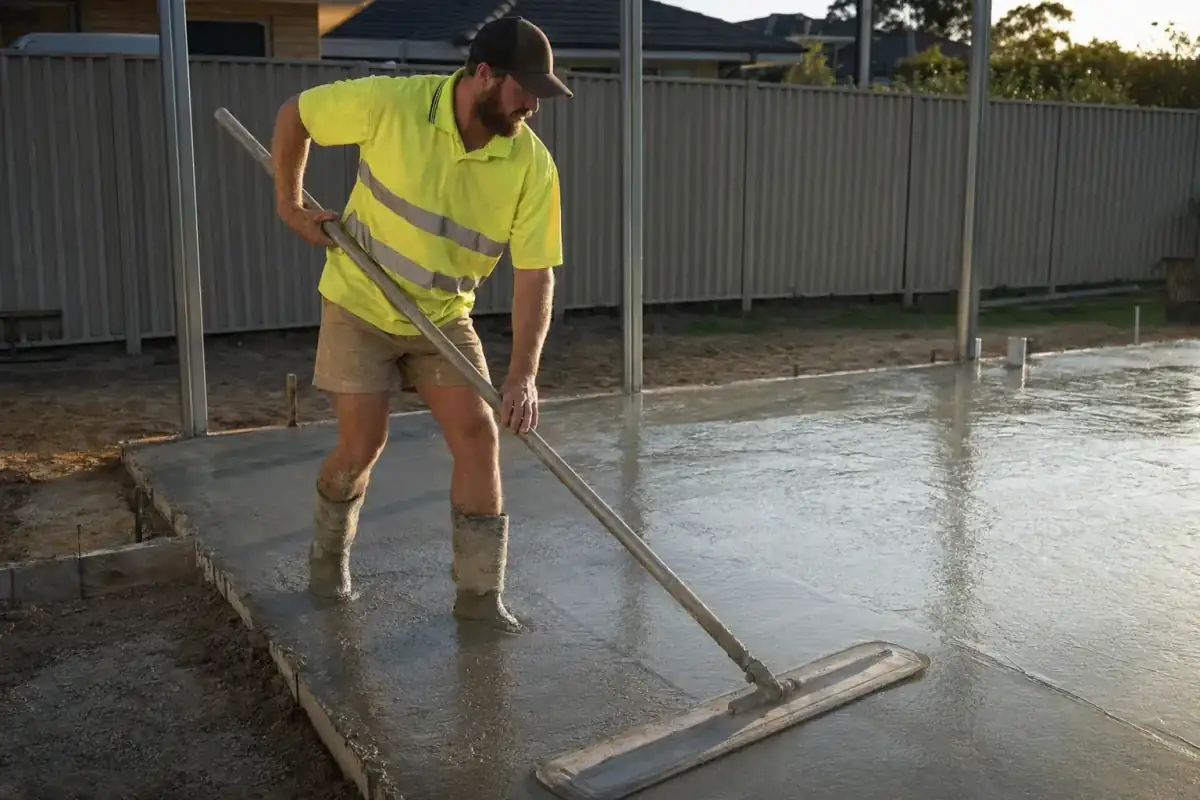
It's poured the same way as a regular slab, formed up, reo-tied, mixed on-site or delivered, screeded and trowelled. The difference is the mix design.
Where it doesn't suit
- Heavy-traffic driveways, the surface scuffs more easily than plain concrete under car tyres
- Industrial sites or workshops, the limestone aggregate is softer and chips under impact
- Northern WA (Karratha, Port Hedland), the iron-ore dust stains the pale surface permanently
- Inside garages, looks great but the colour shows oil drips immediately
The maintenance schedule
- 1
Year 0, Pour + initial seal
Sealed at hand-over with a penetrating sealer + a topcoat for stain resistance.
- 2
Year 1-3, Wash quarterly
Hose down + soft brush. Avoid acid cleaners, they etch the surface.
- 3
Year 3, First reseal
Pressure-wash, dry, fresh sealer applied. ~$8-12/m² to do.
- 4
Year 6, Second reseal
Same process. By now the surface might have a few hairline cracks, patch them in this round.
- 5
Year 9 +, Ongoing 3-year cycle
Continue 3-year reseal cycle. With the resealing kept up, the surface lasts 25-30 years.
What to ask in the quote
- Slab thickness (100mm minimum, 125mm if pool deck takes furniture or umbrellas)
- Reo spec, SL82 mesh + 50mm bar chairs minimum
- Falls, minimum 1:80 AWAY from coping AND across surround toward strip drains
- Strip drain spec, minimum 100mm × 1m every 8m of run for poolside surrounds
- Sealer brand and topcoat detail (penetrating + film-forming combo is standard)
- Colour matching, most operators offer 4-6 standard tones. Get a sample panel first.
- Coping interface, how the limestone meets the pool coping (saw cut + mastic seal is the durable detail)