Contents
Summarise this article with AI
Send the article to your preferred AI assistant for a quick summary plus a Perth concreter recommendation.
AI Overview
Stamped concrete patterns in Perth fall into four main families: slate, ashlar (brick/cobblestone), random stone, and timber-look. Slate and ashlar age best in Perth's UV. Random stone is the most forgiving on irregular shapes. Timber-look reads modern but the colour fade is fastest. Prices run $170 to $260 per m² in 2026, with two-tone colour and contrasting borders adding $20 to $40 per m².
Key Highlights
- ›Slate stamp: most popular pattern in Perth, charcoal/grey base ages well
- ›Ashlar (cobblestone): traditional, suits heritage homes
- ›Random stone: forgiving on curved or odd-shaped pours
- ›Timber-look: modern but fades fastest in Perth UV
- ›Sealer + reseal every 3 years is non-negotiable on stamped
- ›Two-tone colour + contrasting border adds $20-$40/m²
Stamped concrete is the closest thing to natural stone you can pour. Done right, a slate-stamped patio reads as Bluestone slate from three metres away. Done wrong, you get blurred patterns, faded colour, and visible release powder ghosting after 18 months.
Pattern choice is the single biggest factor in whether the job will look right in five years. Different patterns suit different houses, and different patterns hide their wear differently.
Here is how to pick a stamped pattern for a Perth home, and what to expect from each option after the first summer.
The four pattern families
Almost every stamped concrete pattern you'll see in Perth falls into one of four pattern families. Within each family there are 6-12 specific stamp mat designs, but the family determines the look and the long-term behaviour.
| Pattern family | Best for | Worst for | UV ageing |
|---|---|---|---|
| Slate | Modern courtyards + patios, contemporary builds | Rustic / heritage homes | Excellent, earth tones hide fade |
| Ashlar (brick / cobblestone) | Heritage homes, traditional layouts | Modern minimalist | Good, small unit pattern hides discoloration |
| Random stone (Italian / European) | Curved pours, irregular shapes, pool surrounds | Long straight runs (looks repeated) | Good |
| Timber-look (plank) | Modern minimalist, decking replacement | Heritage / traditional | Poor, long planks show fade lines |
Pattern is locked at pour-day
You cannot change the stamp pattern after the concrete sets. The pattern is pressed in while the concrete is plastic, a 90-minute window after the bull-float. We bring the stamp mats to site already cleaned and ready to go.
Slate, the Perth default
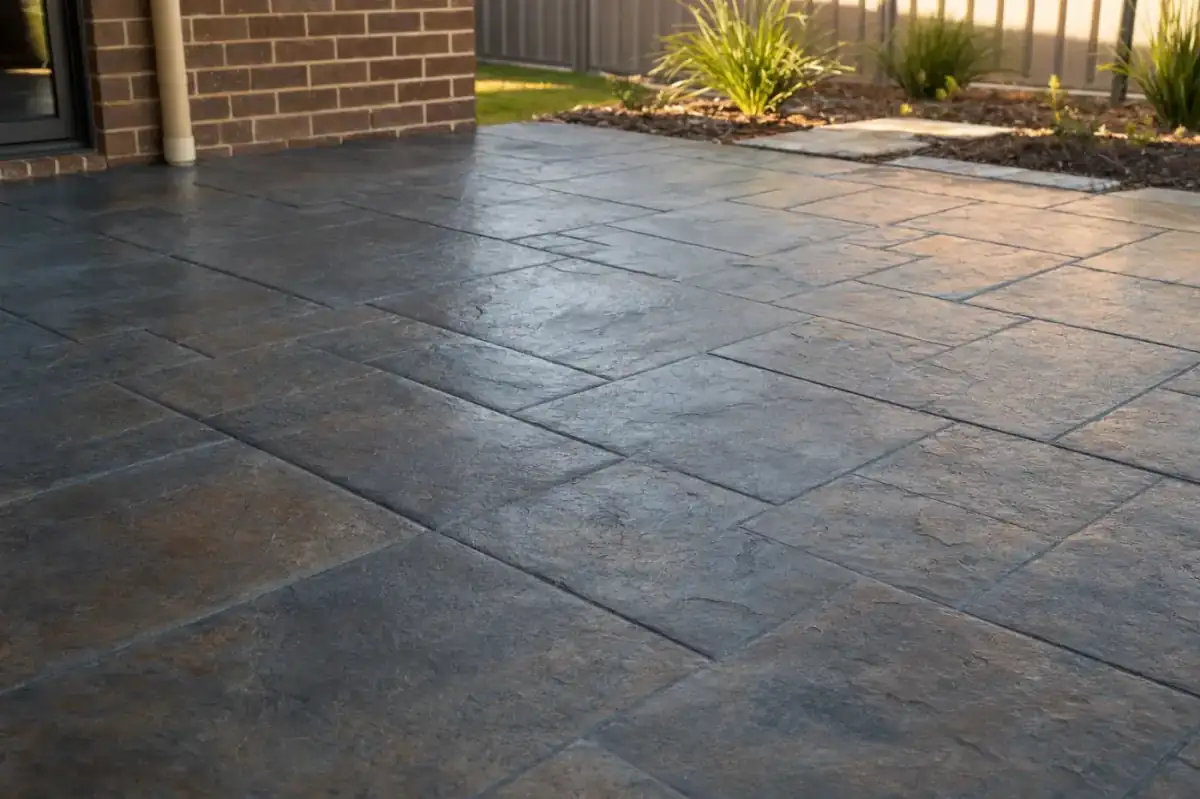
Slate is the most-poured stamped pattern in Perth, and there is a reason. The earth-tone colour palette hides the typical concrete imperfections (fine cracks, surface variation, sealer aging) better than any other pattern.
What slate looks like up close
A slate stamp is irregular tile shapes (40-60cm) with rough textured tops and tight grout-line joints. The colour is achieved with a charcoal or grey base coat plus a contrasting release powder (rust, slate-blue, or warm brown) that lodges in the texture grooves.
- Charcoal base + rust release, the most popular Perth slate combo
- Mid-grey base + slate-blue release, modern look, suits coastal homes
- Sandstone base + charcoal release, warm Mediterranean feel
- Black base + grey release, high-contrast, works around modern pools
“If a homeowner asks 'what stamp pattern is the safest choice?' the answer is slate. Hardest to get wrong, easiest to live with.”
Ashlar, for heritage homes
Ashlar is the cobblestone / brick / cut-stone family. Smaller unit sizes (15-25cm) arranged in regular or irregular patterns. Reads as traditional masonry from a distance.
- 1
Running bond
Brick-style offset, most common ashlar variant. Reads as a path or driveway in a heritage suburb.
- 2
Herringbone
Diagonal interlocking pattern. Slower to stamp, more expensive. Reads as garden walkway or feature patio.
- 3
Random ashlar
Mixed unit sizes. Most natural-looking, hardest to stamp cleanly.
- 4
Roman cobblestone
Rounded edge stones. Suits Mediterranean / Tuscan-styled homes.
Ashlar shows pour seams
Ashlar is unforgiving on pour seams. If we have to do a cold joint mid-job (truck delay, weather), the seam will be visible through the pattern. We schedule ashlar pours for one continuous truck delivery.
Random stone, the forgiving option
Random stone (Italian flagstone, European cobblestone, etc.) uses irregular natural-stone-shaped units in non-repeating layouts. Best pattern for curved pool surrounds, irregular patios, and any pour where you want the pattern to disguise the shape.
Downside: random stone reads as pattern-stamped concrete more obviously than slate or ashlar. Up close, the irregular shapes are clearly mat-pressed rather than naturally laid. From 3+ metres away, indistinguishable.
Timber-look, modern but fades fast
Timber-look (or plank) stamps create the appearance of long timber decking boards. Pattern is straight, parallel planks 15-25cm wide with knots and grain texture pressed in.
It reads modern, especially in dark grey or charcoal. But Perth's UV is brutal on this pattern, long parallel planks make any colour fade visible as banding within 2-3 years. Reseal every 2 years to slow the fade, but plan for the colour to drift over the life of the slab.
Use timber-look in shaded courtyards
If you love the timber-look pattern, use it in shaded covered alfresco areas where direct UV is limited. Lasts 10+ years looking good. Open patios in full sun: the colour drift is unavoidable.
Colour selection, base coat + release powder
Stamped concrete colour comes from two layers. The base colour is mixed into the wet concrete or applied as a colour hardener at trowel stage. The release powder is the contrasting tone applied just before stamping that lodges in the texture grooves.
| Base colour | Best release powder | Reads as |
|---|---|---|
| Charcoal | Rust | Aged slate |
| Mid-grey | Slate-blue | Bluestone |
| Sandstone | Charcoal | Mediterranean limestone |
| Light brown | Black | Aged terracotta |
| Black | Silver-grey | Modern volcanic stone |
Two-tone vs single-tone
Two-tone (different base + release) is more visually interesting and ages better, the contrast tone hides surface wear. Single-tone (matched base + release) reads more uniform but shows wear faster. We default to two-tone unless a client specifically wants the uniform look.
Sealer is non-negotiable
Stamped concrete without a sealer will lose 60% of its colour in the first 2 years. The release powder is loose pigment held in the surface grooves, without a sealer locking it in, foot traffic and rain wash it out.
- 1
Day 28, first sealer
Solvent-based acrylic sealer with 'wet look' enhancement. Two coats.
- 2
Year 3, first reseal
Light pressure-clean, dry, fresh sealer. Around $8-12/m².
- 3
Year 6, second reseal
Same process. Patch any hairline cracks before sealing.
- 4
Year 9+, ongoing 3-year cycle
Continue 3-year reseal until pattern wear demands a re-stamp (typically year 25+).
Pattern + base relationship
Pattern complexity affects the underlying slab spec. Heavily-textured patterns (deep slate, rough cobblestone) need a slab thickness 10-15mm thicker than plain concrete to keep enough body under the pattern grooves.
- Slate / random stone: 100mm minimum slab thickness
- Ashlar / cobblestone: 110mm minimum (deeper grout lines)
- Timber plank: 100mm OK (shallower texture)
- Custom deep-relief patterns: 125mm minimum